Wedding gown alterations price list: how to build one that pays you
This one is for seamstresses. If you're a bride wondering what your alterations might cost, our sister site has a guide written for you.
Brides ask for a price list because they want to know they won't be surprised. Seamstresses avoid writing one because every dress is different, and a fixed price feels like a trap.
Both are right. The answer is a price list built from time, set out by complexity, with a clear note that the final quote comes after a fitting. It gives brides a fair idea up front and it protects you from the lace hem that takes three hours.
Why most bridal price lists don't work
The usual bridal price list has one line per job: "Hem: from $150." That "from" carries a lot of weight, and brides know it. Every quote becomes a negotiation about why her dress costs more than the number she saw.
The other problem is where those numbers come from. Most are copied from another studio, nudged up or down, and never checked against how long the jobs really take. Some lines end up profitable and others quietly lose money every time.
Step 1: list the jobs you actually do
Go through your last six months of tickets and write down every bridal job. Most studios end up with 30 to 50 lines, grouped something like this:
- Hems (by layer count and skirt width)
- Take-ins and fit (side seams, darts)
- Bodice and bust (cups, boning, bust build-up, necklines)
- Straps and sleeves
- Backs and closures (zips, corset backs)
- Trains and skirts
- Bustles
- Steaming and pressing
- Small parts (buttons, bustle points)
Step 2: give every job a time at each complexity level
For each job, you need your usual time on a plain dress. Then you need it again for every harder version that job comes in, such as a lace edge you work around or beading you lift and reset. Not every job needs every level. Nobody adds lace to a waist stay.
Use your own timed jobs where you have them. Where you don't, the Bridal Alterations Time Guide gives usual times and realistic ranges for over 40 bridal jobs, drawn from real timed work in a bridal studio.
Step 3: multiply by one hourly rate
One rate, every job. Lace and beading cost more because they take more time, not because you've invented a surcharge. That makes your list easy to explain and easy to update.
Not sure what your rate should be? Work it out properly first: how much to charge for alterations. For minimums, rush fees and fittings, see the seamstress pricing guide.
A worked example at $110 an hour
Here is part of a bridal price list built this way. The times are the usual times from the Time Guide. The rate is an example only, so swap in your own. Prices are rounded up to the nearest $5.
| Job | Plain | Lace or trim | Applique or beading |
|---|---|---|---|
| Hem, one layer | $55 | $110 | $220 |
| Hem, two layers (main and lining) | $165 | $220 | $330 |
| Hem, wide A-line or ballgown skirt | $220 | $305 | $415 |
| Side seams in, underarm to waist | $110 | $195 | $385 |
| Back taken in through the zip | $140 | $220 | $330 |
| Straps shortened | $55 | $85 | $110 |
| Train removed or shortened | $165 | $275 | $385 |
| Bustle, moderate (about 10 points) | $140 | ||
| Zip replaced (invisible) | $140 | ||
| Corset back added (plus kit) | $110 | ||
| Steam, wedding dress | $85 |
Small parts, each: extra bustle point $15, hook and eye $17, hand-sewn button $4.
Minimum charge: $30. A basic three-point bustle takes around 15 minutes, so it comes in at the minimum.
A few things to notice. The same hem runs from $55 to $220 depending on the dress. A bride with a plain crepe gown pays for a plain crepe gown, and a bride with a beaded lace edge can see exactly why hers costs more.
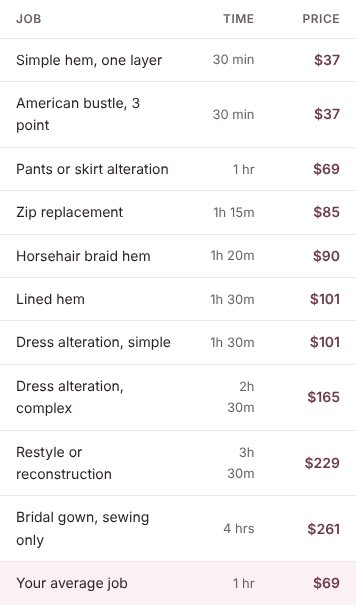
Step 4: add your house rules
Put these under the list so there are no surprises:
- Quotes are confirmed at the first fitting. A photo can't show you the lining or how the lace is attached.
- Materials are extra. Horsehair braid, zips, cups and boning are charged at cost plus handling.
- Fittings. Say whether they're included or charged separately.
- Rush fee. Say what counts as rush and what it costs.
- Minimum charge applies to every ticket.
- A signed contract before work starts, covering deposits and cancellations.
Step 5: review it every year
Your costs go up every year, so your rate should too. Around 10% a year is a good target. We like to do it in September, just as the bookings start flooding in, so you're not second guessing yourself in the quiet months. If your list is built from time × rate, updating it means changing one number, not rewriting fifty lines.
Re-time your most common jobs once a year too. You'll get faster at some things, and you'll find others have crept up because you've started doing them more carefully.
Should you publish your price list?
In 2026, yes, at least as a guide. Brides research everything online before they enquire. A published price list, even one that says "from" and "final quote at your fitting", tells them you're upfront and helps them budget. It also filters out the enquiries that were never going to book, which saves you hours of messages.
You don't have to publish every line. Many seamstresses show their most common jobs with a price range for each, and keep the full list for the consult.
The easiest way to show ranges is by dress shape, because a hem on a slim sheath and a hem on a full ballgown are very different jobs. Our Website Price List Maker does exactly that. Enter your hourly rate and times, and it builds a price guide you can paste straight onto your website, split into sheath, A-line and ballgown. Either way, having the full list behind the scenes means every quote you give is consistent and every job pays you the same hourly rate.
Back it up with a written contract so the bride knows exactly what she's agreed to before work starts. We're putting together contract wording for bridal seamstresses, so follow along below to hear when it's ready.
Skip the spreadsheet maths
Building this list by hand means a few hundred multiplications and a lot of rounding. The Price Sheet Builder does it for you. Enter one hourly rate and your minimum charge, and it fills in a full bridal price list by complexity level, with small parts per unit and materials on a separate line. Change your rate next year and the whole list updates.
Pair it with the Bridal Alterations Time Guide for benchmark times, then replace them with your own as you time your jobs using the free bridal sewing stopwatch.
Tools built for seamstresses, not brides
Most alterations websites are written for brides. The Bridal Sewing Room is different. Every product we make is for seamstresses, to help you build a bridal business that pays you properly, and each one is built and used inside a working bridal studio.
More are on the way, including contract wording for your bridal clients. Follow The Bridal Sewing Room on Gumroad and you'll hear when each new one comes out.
Price your work properly
Tools made inside a working bridal studio, from a free hourly rate calculator to a ready-made price sheet.
Browse the shop