How much to charge for alterations (and why your rate is probably too low)
Most seamstresses set their rate by looking at what the shop down the road charges, then knocking a bit off. It feels safe. It is also how good sewists end up working sixty hour weeks and still wondering where the money went.
There is a better way to answer "how much should I charge?", and it takes about ten minutes with a calculator. You start from the wage you want plus what the business costs to run, and divide that by the hours you can actually bill. The hours are where almost everyone goes wrong.
Step 1: decide what you want to take home
Start with a yearly figure. Not what you think the market will bear, but what you need to live on and what the work is worth to you. For this example we'll use $85,000 a year before tax.
If that number makes you nervous, sit with it for a minute. A skilled bridal seamstress is doing precise work under deadline pressure on a garment that might cost more than a car payment. That is worth a professional wage.
Step 2: add what the business costs to run
This is everything that isn't your wage. Rent or the share of your home you use for the studio. Electricity. Insurance. Machine servicing and replacement. Thread, needles, interfacing, pins and all the small things you go through without noticing. Software, your website, accounting fees, advertising, super for yourself.
Go through last year's bank statements if you have them. Most home-based seamstresses land somewhere between $10,000 and $25,000. For our example, call it $20,000.
So the business needs to bring in $105,000 a year.
Step 3: count the hours you can actually bill
Here is the part that changes everything. You might be in the studio 38 hours a week, but you are not sewing paid work for 38 hours a week.
Think about what happens for every single client before and after the sewing:
- A fitting of 10 to 60 minutes
- Texts and phone calls, plus answering all the other questions
- Writing up the notes and the invoice
- Racking the garment, then finding it again
- Threading the machine and winding a bobbin
- Hunting for the matching cotton
- Pressing and steaming, then rebagging and reracking
- Contacting the client when it's ready
- Another 10 to 45 minutes for the pick up
None of that is sewing, and most of it happens for even the smallest job. Then add cleaning, bookkeeping, social media, holidays and sick days.
When we've timed it accurately in a working bridal studio, sewing comes out at about 50% of studio time. The other half is everything above. Most seamstresses guess far higher, and that guess is exactly what keeps their rate too low.
A realistic way to work it out:
Paid hours = working weeks × studio hours a week × about 50%
Let's run two versions.
Full time, 38 hours a week: 46 weeks × 38 hours = 1,748 studio hours About 50% of that is paid sewing = 874 paid hours $105,000 ÷ 874 = about $120 an hour
Part time, 25 hours a week: 46 weeks × 25 hours = 1,150 studio hours 50% paid sewing = 575 paid hours $105,000 ÷ 575 = about $183 an hour
The part-time figure surprises people. Your costs don't halve when your hours do, so each paid hour has to carry more of them.
Why "income divided by 2,000 hours" doesn't work
A lot of online calculators take your target income and divide it by a full-time year, something like 1,400 or 2,000 hours. That assumes every hour you're in the studio is an hour someone pays for. It never is.
Run our example that way and you get $75 an hour. Charge that for 874 paid hours, and the business brings in about $65,500, not the $105,000 it needs. We're building an in-depth hourly rate calculator that does this properly, with your own studio hours and your own sewing share. You'll feel busy the whole time, which makes it hard to spot.
Step 4: turn your rate into job prices
Brides don't buy hours. They buy a hem or a bustle. So once you know your rate, the job price is simple:
Job price = your usual time for that job × your hourly rate
Say a two-layer hem on a plain dress usually takes you 1 hour 30. At $110 an hour, that's $165. If the dress has a lace edge you have to lift and reset, it might take closer to 2 hours, so $220.
The hard part is knowing your real times. Most of us guess, and most of us guess short. If you've never timed yourself, start now. Our free bridal sewing stopwatch lets you time each job by stage (prep, cutting, sewing, pressing, finishing) so you can see where the minutes actually go.
If you'd like a head start, the Bridal Alterations Time Guide lists typical times for over 40 bridal jobs, each with a quick end and a slow end, plus notes on what pushes a job up. The ranges come from real timed jobs in a working bridal studio.
Step 5: sanity check against your market
Now you can look at what other seamstresses charge, but for a different reason. You're not copying them. You're checking whether your job prices land somewhere sensible.
In most of Australia, an hourly rate of $110 to $180 turns into job prices that sit right in the normal range for bridal work. If your numbers come out far above the local market, look at your costs and your times before you look at your wage. Maybe a job is taking you longer than it needs to, and that's a technique fix, not a pricing one.
If your numbers come out far below, you've found money you've been leaving on the table.
Premium or budget: where do you sit?
There's a real spread in bridal pricing, and that's fine. Plenty of seamstresses at the lower end do lovely work. On a lot of jobs the difference between a good finish and an exceptional one is tiny, a millimetre here or a stitch you'll never see there.
The studios that can charge at the top of the market have usually earned it in ways brides can feel even if they can't name them. Think of the last few percent of attention to detail, built on years of deliberately learning new techniques. Demand plays a part too, because a studio that books out months ahead can charge more. Just as important, they treat the business side as a skill to learn, and they keep working on their pricing instead of setting it once and forgetting it. Most seamstresses never do that part, and it's the part that moves your rate the most.
A few things that protect your rate
Set a minimum charge. Sewing on one button still means a consult, a ticket, a hang, a collection. A minimum of around $30 is a sensible floor.
Charge lace and beading as time, not a mystery surcharge. If a lace hem takes twice as long, it costs twice as much. That's easy to explain to a bride, and it's fair.
Price rush work properly. Pushing a job ahead of others costs you something real. A rush fee covers it.
Put your prices up every year. Aim for about 10% a year, because your costs rise and your skills grow. The best time we've found is September, right as the bookings come flooding in. You'll see the demand in front of you, so you won't doubt yourself or wonder whether the quiet season is down to your price.
The short version
Add what you want to earn to what the business costs, then divide by the hours you really bill, not the hours you're at work. Multiply that rate by your real times. It's simple maths, but very few seamstresses do it, and the ones who do stop undercharging.
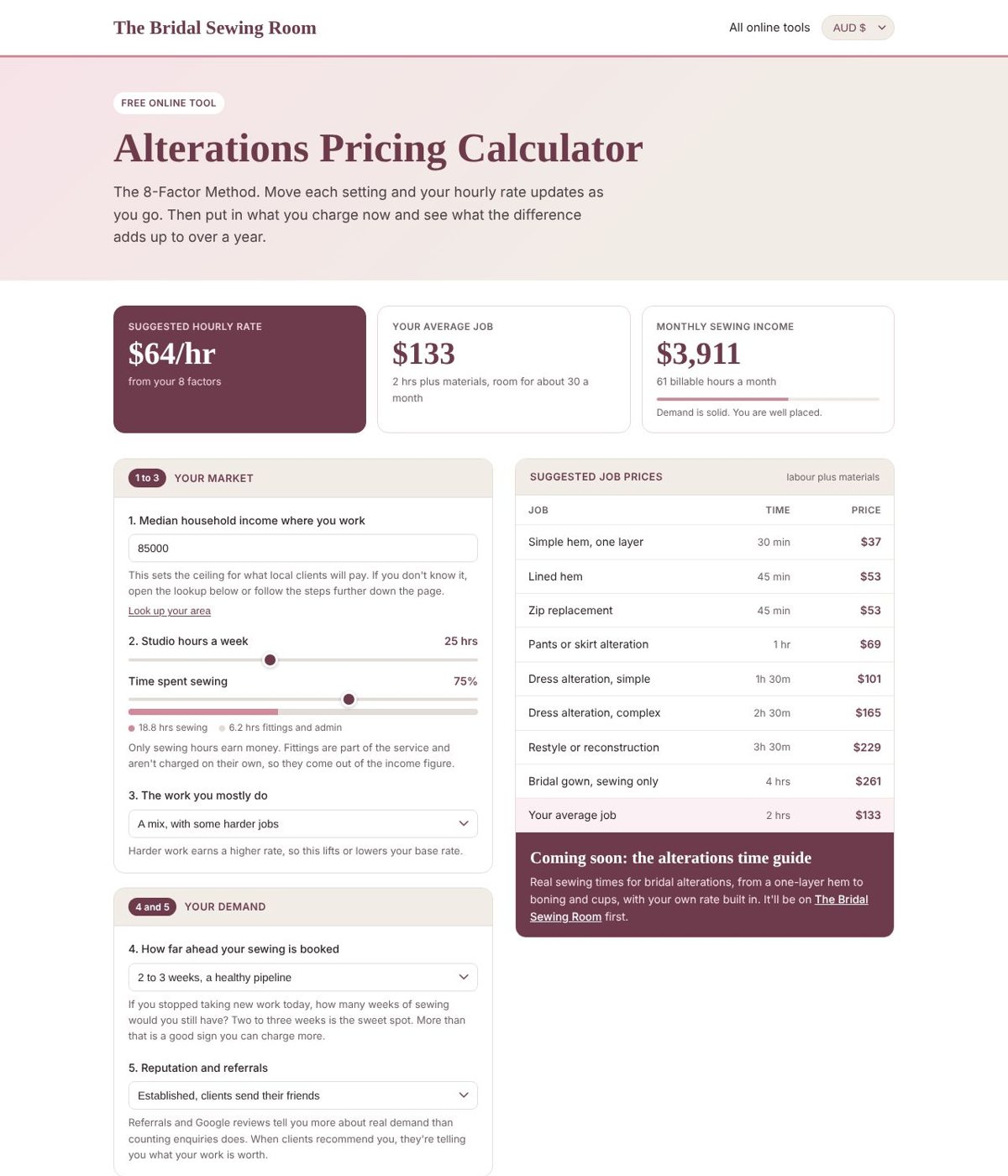
If you'd like to skip the spreadsheet, our free Pricing Calculator gives you a starting rate in a couple of minutes. When you're ready to turn that rate into a full price list, the Price Sheet Builder does the multiplication for every job at once, using one hourly rate you set. Then the Website Price List Maker turns your rate and times into a price guide you can paste onto your own website, split by sheath, A-line and ballgown dresses.
Tools built for seamstresses, not brides
Most alterations websites are written for brides. The Bridal Sewing Room is different. Every product we make is for seamstresses, to help you build a bridal business that pays you properly, and each one is built and used inside a working bridal studio.
More are on the way, including contract wording for your bridal clients. Follow The Bridal Sewing Room on Gumroad and you'll hear when each new one comes out.
Further reading: - Home-based businesses (business.gov.au)
Price your work properly
Tools made inside a working bridal studio, from a free hourly rate calculator to a ready-made price sheet.
Browse the shop